
Please click on the named titles below to read the personal memories shared with Borden Heritage Group
David Harrison's Childhood Memories
Robert Hardy’s memories of Denis De La Billiere
One of the names read out at our Remembrance Day Service is that of Denis De La Billiere, a Surgeon Commander RN who was presumed drowned when his ship, the cruiser HMS Fiji, was sunk by the Luftwaffe in the battle for Crete in May 1941, after thirteen hours of continuous attack from the air. Of the crew, 520 were saved 244 lost. His captain later wrote that Denis was last seen in the water, and “I don’t doubt that he was always trying in his gentle way to go to the help of some neighbouring swimmer in trouble. I’m sure he was pretty exhausted dealing with the wounded before he even got into the water … He was a wholly reliable and respected doctor, and I dare say his very deliberateness gave the confidence that a hasty man could not command.”
His family, his wife, Kitty and his two sons, Peter and Michael, connection with Borden began in 1937 when Denis was posted to HMS Pembroke (Chatham Dockyard) in1937 and rented The Homestead, described by his son, General Sir Peter De La Billiere in his autobiography, as “a typical, red-brick Kent farmhouse, of medium size, lacking in modern comforts, but with a friendly atmosphere. It belonged to a farmer called Mr Hinge who owned and worked all the land around. He was a kind and tolerant landlord even when Michael and I made ourselves an infernal nuisance to him, and the farm, with its large barns and outbuildings, was an ideal environment for boys who liked being outdoors”.
Sir Peter’s autobiography has some very interesting insights into life in wartime Borden. They lived, he says, in real country, among country people, and their lives were shaped by the rhythm of the seasons. He describes the cherry orchards, but the most exciting time of year was the harvest when primitive binders clattered round the fields of corn causing the rabbits to flee.
All this time the war in the air was raging overhead and he relates how one night a fleeing German pilot unloaded a stick of ten bombs which straddled the village, and that one landed in front of the pub but by a million to one chance plummeted straight down a well outside, containing the explosion. At night when an air raid was expected he and his brother would have to sleep under a steel table in the cellar, but in the morning, they were free to search the fields for pieces of shrapnel, empty cartridge cases and rounds of ammunition which had failed to fire.
In October 1937 he had started at the Frobelian School at 58 Park Road in Sittingbourne. This, incidentally, was a school I myself started at some five or six years later, no doubt on the recommendation of his mother, Kitty, who had become a close friend of my mother.
Sadly, it seems that Peter’s days at Borden did not end entirely happily because, returning home one day, he found a new and by no means welcome element had entered his life. His mother and Major Maurice Bennetts were married at a quiet wedding in Borden Church early in 1943. He, of course, never blamed his mother, who was, he says, still a lively and attractive woman in her mid-thirties, for the new alliance on the rebound from his father’s death, but he and his brother at once took against their step father, and the marriage quickly proved disastrous after the family left Borden and moved to Shropshire.
Robert Hardy
January 2026
Robert Hardy (Memories - 2025)
Memories of Victory in Europe (VE) Day
There cannot be many still living in Borden who remember 8th May 1945. I was just 6 years old and, apart from attaching British, USA and Russian flags to our front fence in Wises Lane, I remember similar signs of victory appearing down The Street. Of especial excitement to me though were the lines of Union Jack bunting being stretched from the upper windows of The Maypole across to the same at Forge House by two soldiers in army uniform, young sons of the Pankhursts and the Sherlocks respectively.
Three months later in August the country celebrated V J DAY, of course, and on this occasion I was in the children’s ward of Maidstone ENT Hospital recovering from having had my tonsils and adenoids out. I remember Matron coming in one morning and excitedly sweeping the curtains aside in celebration and declaring that Japan had surrendered and that meant her nephew, obviously a prisoner of war of the Japanese, would soon be released.
Robert Hardy
January 2025
Sally Wilkinson nee Clark (Memories 2025)
Sally Wilkinson nee Clark Thatch Cottage Wises Lane 1952-1966 memories
My parents, Philip & Ruth Clark, together with my brother David & myself moved into Thatch Cottage in 1952.
The 17th century cottage had been lovingly restored by a local firm during the early 1950’s, having previously been multiple cottages. The end cottage was still inhabited by Stan & Nellie when we moved in and when they died my father bought their cottage to complete the size that it is to this day.
During the process of restoration my father had been taking a keen interest in the work & took many photos as a record of the transformation. I can remember seeing them and was amazed at how the cottage was brought back to a suitable dwelling from a dilapidated shell.
Very sadly these photos, together with many other treasures, were lost when a burglary took place during the 1970’s & the walnut table in which they were stored was stolen.
These photos were part of the interesting, irreplaceable history of the property dating back to Tudor times with the various shaped oak beams & fascinating architecture. History lost forever, very sad. My father got the cottage listed as a Grade 2 building in 1984.
My memories of Thatch Cottage include draughts, big open fires, no central heating & having to do my piano practice in a room where the ice was on the inside of the windows, watching the mice running between the thatch & the wire netting outside my bedroom window! The sound of death watch beetles in the beams was really strange. The spacious garden which was regularly visited by jays.
The low beams caught many a visitor by surprise as they bumped their heads, followed by colourful expletives!
My father bought a brass ship’s bell for the front door which was stolen one night right beneath my bedroom window but I heard nothing.
Whilst living in Borden I enjoyed many years of freedom in this lovely village. I made some great friends, sharing in their respective lives & enjoying spending time with them.
I became great friends with Wendy Bishop from Home Farm, who had a beautiful pony called Bracken & we had many happy hours of fun over a number of years in the mid-late 50’s.I was delighted when Wendy had a baby sister Elizabeth as I loved babies!
Other names that come to mind are Monica Smith from near the Forge, Ann Coker opposite the Maypole, Brenda Sewell who lived a few doors down from the local shop – (Wood’s Stores if I remember correctly). Brenda & I shared a love of Marmite crisps!
I spent many hours with Christine Valentin who lived near Harman’s corner with her parents and 2 brothers Malcolm & David.
Another great friend was Valerie Davison from Heart’s Delight Road. We were in Borden church choir together with Gillian Kift, whose father was the organist. We were rewarded for going to church and also the choir practice 2d each time!! This is where I got married in 1966 – Rev. Phillips was the vicar.
I recall taking part in a pageant but I can’t remember what it was in aid of but by the look on the faces of the photo I have the children all looked rather bored myself included!!
In the mid 50’s I went to Sunday School & after a short while I was asked to lead a class in the old village hall. I remember in 1957 we put on a Christmas play when we enacted “In the bleak mid-winter”, various children were dressed up but I wasn’t as I was the child depicting “What can I give Him poor as I am? If I were a shepherd, I would give a lamb. If I were a wise man, I would do my part yet what I can, I give Him – Give my heart “. For me this was quite a moving part to play.
Others in the play included Monica Smith, Margaret Phillips, Dulce Woods, ? Lambert, Julia Hollis? Christine Valentin .
This is the hall where my mother went to the WI meetings & it was also used for the baby clinic where she took my baby sister in 1958 to be weighed.
Borden Fete was the highlight of the year. In 1958 I was asked to run the“bucket in the ball” stall which raised the princely sum of £2.10s. According to my diary I won the flower pot race and came 3rd in the running race!
The day after the fete my friend & I went to pick up rubbish but went home having found a few pennies as well!! Then off to Wood’s to buy a few sweets!
I remember my mother used the shop for much of her groceries before supermarkets! She would put her purchases “on the book” and pay once a week.
I really enjoyed stopping by at the forge to watch Mr Sherlock, the skilled blacksmith, attending to the horses “shoes”, really fascinating.
Living as I did opposite the lower entrance to the Playstool I would often ask to take out neighbour’s babies for a walk where we would have great fun. One of the babies was Julia Lane who lived in part of Wises House with her Swedish mother and also Ann Devison who lived in the house at the entrance to the little pathway leading up to the top end of the Playstool where the swings were. I recall Ann’s mother was an amazing dressmaker!
Another memory which has stuck in my mind was going through a gap in the fence on the lower Playstool & scrambling down the bank to the chalk quarry where I watched the butterflies and was really thrilled to see wild orchids growing there. I guess this is where the nature reserve is now.
Sally.
Roger Martin (Memories 2022)
Roger’s Memories
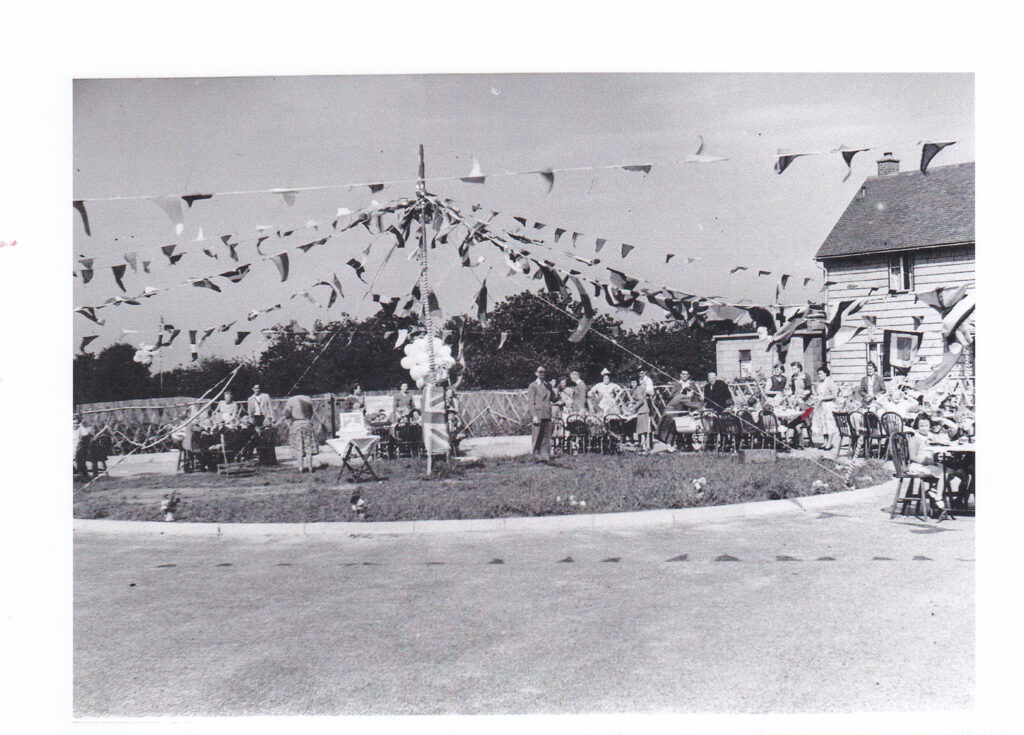
I had a question posed to me from a friend that I grew up with on the old Mount View Estate, that you may be able to answer for me, the photo that I have provided was taken of No 25 and No 27 Mount View Borden at the celebration of the coronation of Queen Elizabeth the 2nd . I lived at No 25 (on the right) and the Parkhouse family lived at No 27, my question is – in the middle of the green there was a large Weeping Willow Tree, when was it planted and was it planted for a special occasion? As can be seen there is not a tree on the green and if it was planted for a special occasion then what was the occasion? The only one I can think of is the Coronation of the Queen, but I may well be wrong.
If per chance you find the answer can you, please put it on the BHG page as there are a few from the Estate that I’m sure would be interested in the answer.
Incidentally the clown is performing at the same occasion the street party for the coronation of the Queen and I do believe it was Mr Fielder who lived on the Estate that played the part of the clown
Wed 02/11/2022 04:56
Ian Smith (Memories 2013)
Michael Smith Born and bred in Borden
I came across this site by Googling “Borden Chalk Hole” – a place where I spent many happy hours during my childhood – which brought up the contribution made by Roger Martin (now living in Australia), who I knew well, along with his twin brother, Keith and older brother, Ian.
I was born in 1948 and went to the Chalk-Hole College where I was taught by Miss Alice Edwards, initially, and later by her sister and Mr Jenkins, then ultimately by the much-feared Mr Costin. Mrs Costin taught music, though learning to sing “halloa halloo, a hunter gay am I” did not inspire me much, and by 1958 I had latched onto Cliff Richard and The Shadows.
My childhood chums included Billy Todd, Micky Parish, David (Jumbo) Young, Chris Barton and Roy Stickles. I am still in touch with Roy..
My parents were Jack and Vera Smith who lived in the middle one of the Rose Cottages terrace which is next to the forge pond – never a real pond in my lifetime and filled-in recently – almost opposite the gate to The Playstool.
Jack and Vera are buried in the churchyard within sight of their long-time home, where they raised Michael (now deceased and sharing the family grave), Monica, myself and younger brother Martyn. We were spread over a remarkable nineteen years! Michael was church organist for about half a century, with occasional absences whilst serving in the RAF.
Mr Costin getting the “ride-on” motor mower from a farm barn and piloting it down Wises Lane to the lower Playstool entrance was always a source of excitement: the prospect of being allowed to have a go on the mower thrilled me on every occasion, though it actually never happened.
The annual fete included a display of Maypole dancing by the pupils of Chalk Hole College. Sadly, during practice sessions in the school playground, I was found to be particularly inept, having managed to get the ribbons tied up in knots, so I was consigned to record player duties. I proved to be not very good at that either – taking the needle of the track prematurely on more than one occasion.
When the dancing went wrong at the fete, as it invariably did, Mr Costin always told the amused crowds that he always wanted some mishaps to show that it wasn’t as easy as it looked!
The Austin (or Austen) family moved in at the Forge house as Jim Austin followed on from George Sherlock as village blacksmith, and I gained a new friend, John, who had a younger brother, Arthur. They had come from a place I had never heard of before (or since!) – Cowden – somewhere close to the Sussex border. We used to throw sticks or stones up into the conker trees at the entrance to Borden Hall, and also in the churchyard where a tree grew opposite the “new” vicarage.
Playing conkers was an essential part of growing up in a village, and owning a prize conker – one that had survived several games – was a real status symbol: the conkers accordingly grew titles like a “fiver” or “sixer” depending on their number of victories. Mr Costin sent Billy Todd out to gather some conkers to bring back to the classroom, but nobody knew why until Mr Costin started throwing them by the handful back at Billy to reinforce the point that King Harold had lost the Battle of Hastings to William the Conqueror, and not as Billy had spelled it: CONKERER! Despite being generally regarded as an ogre, Mr Costing evidently had a sense of humour.
Mr Costin got into the habit of playing a radio broadcast lesson to us one day a week, but to his horror, on one occasion an unexpected sex lesson was broadcast, and as this dreadful event began to unfold, he wriggled and squirmed, blushed bright pink and said “Do we usually have the radio on today?” to which the highly amused kids – realising his obvious embarrassment – unanimously cried “YES”.
I could go on for ever with tales of adventures in the pug hole and chalk hole – playing with unimaginable items of industrial waste dumped there; not to mention sliding down steep cliffs and using the rusting disused quarrying equipment as a carousel. But there you are – I survived to tell the tale. No children came to grief there as far as I can recall.
Ian Smith 2013
Roger Woods-Flack (Memories - 2012)
Memories of the village circa 1953 = 1960
Roger Woods-Flack
I have recently been contacted by Roger Martin a guy who I went to Borden school with and how wonderful it was to hear from him. He has prompted me to write to you with a few memories of my time in the village. I lived in Pond Farm Road in a little bungalow near to Sutton Barron Road, there was only one other house closer to the triangle in the road which was called “Primrose” owned by a farmer John Veitch. He was married to Ethel Veitch.
We owned an orchard which was behind our bungalow and I loved it dearly but my passion was to go with John Veitch to his farm at Bredgar. I spent more time in “Uncle Johns and Auntie Ethel’s house than I did in my own.
It was an idyllic time for me, I am so grateful to Roger Martin for all his information which has allowed me to remember some of the persons I knew then.
I remember walking to Borden primary school along the narrow Pond Farm Road and School Lane or walking through the orchards instead of using the roads and playing with my friends, most of them from the Mount View estate. What times we had, every day was a joy. It was only later when I had moved away did I realise what a wonderful life as a child I had had.
I especially remember the Todd family who lived in Mount View. My mother was not well and my father employed Mrs Todd to clean for us. Mrs Todd, Mr Todd, Ron Todd her eldest son and Billy her youngest son became family friends and I know that we all held Mrs Todd especially, in very high regard. I am not so sure that much cleaning was done but I do know that my Mum loved every minute of Mrs Todd’s visits. They would sit and drink tea and talk. Strange that in those days everyone was either Mr or Mrs, rarely first name terms but never the less dear friends. Mr Todd came to help pick the fruit, he came on a motorbike and side car. My Dad would also pick the fruit and would sing at the top of his voice, mainly “Jesus wants us for a sunbeam” How Mr Todd managed to cope with it I don’t know as my Dad could not sing a note.
If anyone knows of the whereabouts of the Todd family I would enjoy very much getting in contact again.
I have so many happy memories of this wonderful place and of the people who lived there just after the war. I don’t think people had a lot of worldly goods then but they were, I remember, mostly kind and considerate. I have to say that this small enclave of Borden Oad Street and Bredgar is to me exactly what Britain is all about and I feel blessed to have been a small part of it.
Roger Woods-Flack then Roger Woods 2012
Joyce Martin - nee Sherlock (Memories - 2011)
Joyce Martin’s (nee Sherlock) Memories
Joyce’s father was the village blacksmith in Borden. His family had lived in the village for several generations. His name was George Cecil Sherlock and having married Minnie May Wittingstall from Faversham, he lived in Forge House from 1922 until his death in 1957, when he was in his early 60s. George had been a farrier looking after army horses during World War 1. He was succeeded as the village blacksmith by Mr Austin.
Joyce’s earliest memories are of Cranbrook Convalescent home, because when she was 5 years old she contracted T.B. and was away from Borden for about one year. Her parents visited her each week travelling from the village by motorbike and sidecar. She returned to Borden village school, but missed a fair amount of schooling through illness. Every Monday she had to attend for a check-up at a clinic at the bottom of Borden Lane. Her doctor was Dr. Robson of Hollybank Hill.
Joyce’s older sister, Marjorie, had been born at a house in Chestnut Wood, while her father was working at the forge in Chestnut Street. Joyce was born in 1923 and her twin brothers, David and George, were born in 1927. As the family grew up they would often visit Leysdown on Sundays and search for cockles. These would be cooked on Mondays, while her mother was busy with the never ending pile of washing, which was washed and boiled in the copper in the scullery.
George the blacksmith was also a wheelwright and so he made many of the wheels for local farm carts. These wheels would be put on the plinth, which can still be seen outside the forge. His wife would be called to help stretch the heated tyre over the frame and if the children were about they would run around with watering cans cooling down the metal. Freddie Payne, a local inhabitant, would often sit on the wall next to Rose Cottage and the forge repairing villagers’ shoes, while watching the comings and goings at the forge.
Joyce’s father was kept busy looking after the horses that worked at Street Farm opposite the church and at Home Farm in The Street. His wages were governed by the farmers and he would get 25 shillings (£1.25) for shoeing each cart horse. The farms were busy places with the horses going about their daily work. There was a regular competition between the farms and the horses would be paraded with their gleaming brasses and braided manes.
Forge House was a large house with three bedrooms and a dressing room that was also used as a bedroom. The meeting room for the Trustees of The Barrow Trust was on the second floor and ran across the two adjoining houses. There being no main drainage at the time there were five cesspools in the garden of Forge House. Friday night was bath night! A zinc bath was filled with water for all the family to use. Rainwater was collected from water butts and boiled-up in the copper before putting it in the bath. Pears soap was used to scrub the children clean. There were no domestic fridges in the 1930s, but the steps to the cellar were used for storing items that needed to be kept cool. During the Second World War, Joyce’s father put matting on the floor of the cellar and white-washed its walls, so that it could be used by the family as an air-raid shelter. When the doodlebugs flew over, the family would spend the night in the relative safety of the cellar and emerge about 6 a.m. The boiler room of The Maypole Pub was hit one night by an incendiary bomb fortunately causing little damage and there was a searchlight battery in School Lane.
A typical weekly menu at Forge House would be: Sunday roast beef, Monday bubble-and-squeak with cold meat, Tuesday liver, Wednesday and Thursday meat pie (that would last for two days)Friday fish, Saturday sausage meat pads
The village post office was in Barrow House, which adjoins Forge House.
The old vicarage was a large imposing building in The Street. The Mothers’ Union met in the vicarage. Joyce remembers the Reverend D’Espelier and his wife being authoritarian. If children misbehaved during church services, Mrs D’Espelier would ‘clump’ them around the head with a hymn book! There was a large tithe barn at the back of the vicarage, where Sunday School parties were held. The children would line-up at these events and be given an orange, an apple and some sweets. Joyce remembers that she once lined-up only to be told that she had not attended Sunday School regularly enough and so would not receive the gifts! The fact that she had been ill was not taken into account. Two kind boys in the line gave her their rewards!
Villagers always attended church dressed in their best clothes. Joyce remembers attending church twice a day – for the main service in the morning and then returning in the afternoon for the Catechism.
Two stained glass windows from the church were removed to Canterbury Cathedral for safe-keeping during The Second World War, but unfortunately it is thought it would be too costly to reinstate them.
A pine tree in the Vicarage garden was reputedly left standing as it was a landmark for wartime aircraft.
BORDEN CHARACTERS
Joyce’s Aunt Vi and Uncle Ted lived at Apple Tree House, which had been the village workhouse in earlier times. Their son, Cecil, would often remind them of the origins of their home, much to their annoyance! Vi was responsible for cleaning the church for many years.
Miss Goodger worked at Sutton Baron House. She walked along the footpath beside Miss Greensted’s shop and carried a hatpin with her as protection on the lonely paths.
Miss Greensted (Caroline?) and her mother owned the village shop (where the bridleway to Bredgar leaves Borden opposite the church). The shop was loved by village children for the range of sweets it sold. Cheese and butter were stored in the cellar and brooms and brushes could also be bought at the shop.
Miss Perkins lived in St. Martin’s Cottage. She grew artichokes in the garden and she would get water from a well hidden under flagstones in her kitchen.
P.C. Pike and P.C. Wignall were two local policeman, who patrolled the village and knew the inhabitants well in the 1950s and 60s.
Joyce remembers the village shop being decorated at Christmas and brimming with exciting goodies. The owners at one time were Mr and Mrs Downs. They had an old oak clock which stood on a sideboard near to the stairs to the cellar. Biscuits at the time were sold separately and you could choose the individual types you wanted. Butter was patted up to the amount you wanted. There was a door from the shop to Mr Giles the butcher. Mr Wood would pluck turkeys.
In far more recent times in the 1990s, Rodney Kimber in the village shop is remembered for having a newspaper and a cup of coffee, while he waited for customers in the mornings and changing to a book and a coffee in the afternoons. In the latter days of the village shop, he took an interest in dolls houses and would build them and sell items to go in them.
Long before the Kimbers had the village shop, a Mr Gage would deliver fresh fish in a small white van once a week and there was another man who bought fish and chips to the village in a mobile van.
Mr Hemsley delivered milk by pony and cart. Mr Whitehead from Munsgore dairy also bought milk to the village.
The nearest bread shop was in Neal’s Bakery on the main road (A2) near where The Pines Nursing Home (The Firs) is situated.
Mr Friday was the road sweeper. Each day he would walk from his home in Berry Street in Sittingbourne to Borden. He would then eat bread and cheese for his breakfast and then he would collect his cart for his daily work. He would sweep from the church to Harman’s Corner and he was also responsible for keeping gullies and drains clear and making sure that hedges were kept tidy and in order. Every Saturday he would clean his tools and arrange them neatly in their place of storage, so that they were ready when he resumed work the following Monday.
Joyce’s father, the blacksmith, would also spend Saturdays cleaning his benches and windows and sharpening and cleaning his tools, so that the forge was clean and tidy for work at the beginning of the new week.
Old Sedgey, who lived in a large house situated on the corner of Bannister Hill and The Street, would sell pigeons in the morning at various places away from the village, but being trained as homing birds, they would quickly return to him! He had a son Georgie, who is remembered for often hanging over his fence with a bag over his head!
At Bannister Hill there were four wooden cottages, each having just two rooms and a kitchen. One was lived in by a family of six and in another lived Alfie Hills and his mum. He is remembered for his enjoyment at village fetes of frequently sitting in a wheelbarrow while water was poured over him.
Two ghostly appearances in Borden are of a Spanish lady with connections to Borden hall who is thought to haunt its interior. She is believed to have buried a baby under the yew tree that used to exist close to the west door of the church. Close to Posiers, a lady in a crinoline dress was once seen to float across the road.
SCHOOL DAYS
The village school pupils were involved with the May Day celebrations. A large maypole was erected in the lower field at The Playstool. The boys would wear biscuit coloured smocks and the girls wore white smocks as they danced around it.
In the 1930s Mr Taylor and Mr McCulloch were the headteachers. The cane was used as a punishment in the school. The toilets were away from the main building and would freeze up during the cold winters. The two Miss Edwards wore their hair up and tied in a bun. They wore the same colour dresses – maroon one week and blue the following week. The pupils would queue for Mrs Parker to give them their daily free one-third of a pint of milk with a Horlicks tablet. They were also given regular doses of cod liver oil to keep colds away. Miss Howes rode a motorbike called ‘James’. She had a big weaving loom in her classroom, which the children used to make mats. Mrs Barrett (Joyce’s sister, Marjorie) was the caretaker for twenty-five years and lived in the schoolhouse.
The pupils would play hop-scotch. They used spinning-tops, which they would whip from the church gate to the shop and they would play with iron hoops.
Joyce particularly enjoyed collecting wild flowers from the hedgerows, which were put in 2lbs. jam jars and displayed at school. White mice were kept at school and during the holidays, Joyce volunteered to look after them at home.
Joyce and her friend, Joan Young, would often take a bottle of water and a couple of biscuits and wander in the local farmland, particularly going down the Half-Mile Path to Oad Street, where they would search for newts.
Joyce belonged to the Girl Guides. About a dozen girls used to meet in a house in Borden Lane. They would go camping at Syndale Bottom near Newnham, where she remembers hearing the gypsies singing as they went about their hop picking. The girls also enjoyed charabanc outings to Joss Bay.
During wartime a 6d (penny) Hop was held regularly in the Parish Hall. The hall had previously been an army hut in Sheerness and it was transferred to the village in 1921. Whist drives, dances and amateur dramatics often took place there.
Joyce has fond memories of hop and cherry picking in the local area. She would take bread and cheese and a flask of tea and spend many happy hours picking hops in Cryalls Lane.
She left the village school when she was 14 years old and went to help look after a blind daughter of staff at The Kent Farm institute in Riddles Road. She then went to work for Gobbles shop in the High Street, where Central Avenue is now. They were renowned for hams, but her new employer was a real taskmaster.
PS James was a haberdashery shop near to where The Forum is now. Flannelette for winter shirts would be bought there and the money would be taken in small screwed containers on tracks hanging from the ceiling to a central cashiers’ office.
Close to the Abbey Bank is in Sittingbourne High Street there was a grocery shop called Maypoles. Around the shop were ceramic tiles of rural scenes of cattle in fields. These tiles have recently been rediscovered on the walls in what is now a cafe and so Joyce has been able to admire them again.
A bus to Doddington would pick up passengers from near the forge and take them to Sittingbourne.
Joyce has memories of Borden over a very long time, but she really misses the village shop, which was a meeting place for the local community.
The Forge
I was born in 1919, we moved from Chestnut Street into the Forge House in 1922. My Dad (the blacksmith George Sherlock) used to renew the worn tyres on the wagon wheels, in order to do this he had to remove the big round iron cover which was and still is in front of the Forge, then he had to take off and fix the wheel in the space where the cover was then heat the new tyre on the forge fire. He used to get a bit of help – Uncle Ted Miller, Mr. Payne the shoe mender and anyone in the pub at the time who could stand by with a bucket of water because once the tyre was on it had to be cooled down quickly because the wheel could be set alight by the tyre. My dad made the four arms for the lights in the church when electricity arrived, the old ones had candles which Uncle Ted used to pull up and down on a rope to light, and those same frames are still there.
Recorded by Frances Platten for BHG 2011
Peter Wenband (Memories - 2009)
Memories that Peter Wenband shared August 4th 2009
I was born in the black and white cottages in Hearts Delight Borden on 30th December 1925.
My parents had my current home ‘Beauval’ built in Wises Lane Borden in 1927, they named it Beauval after Bauvais in France where my father served in the First World War.
I have a photograph of my father standing by a house in The Street Borden It was a Ladder makers & Carpenters shop near the boarded house with wisteria. When my father died my mother earned money to raise the family by fruit picking, taking in laundry.
My sister Joan Mills lives in Rainham she will be 86 in October 2009 and she has a very good memory.
We both went to the Borden Primary School in School Lane until we were 14 years of age. I missed a lot of school lessons because I suffered from Asthma and therefore I was not entered for the school examination for entry to The Technical School on Sheppey. At school I remember the two Miss Edwards who taught ‘the little ones’ and I also remember Mrs Parker.
The headmaster was Mr McCullock, he died of a heart attack and Miss Howells became headmistress. Mrs Finlay taught Science and Miss Kift (sister of Reg Kift) also taught us until she died of asthma.
My first job was at ‘Parretts’ the Printers where I worked in the shop and in the office.
I was also an office boy in the stores at Detling Aerodrome.
I moved to work at Wraights the Builders and completed 27 years; I was articled under Reg. Kift. Wraights Drawing office was in the building now used by Lloyds the Chemist and the Wraights ‘works’ were on the land now used as the London Road Trading Estate.
I served as a Building Surveyor at Kent County Council for twenty seven years until I retired.
My mother was born Eleanor Thomas in 1894 in Princes Street Sittingbourne and she died aged 80 years in 1974. Nellie, as she was known, was a member of the Women’s Institute in Borden.
My father was Ernest Wenband; he worked as a secretary at Pullens Garage which was near Holy Trinity Church on the site now used by Focus Do It All. I have a photograph of Pullens found by my niece at the Library.
My Uncle Arthur worked on barges that carried cement and bricks to London and returned with ‘rough stuff’ (coke and ashes) this was mixed with clay and used in brick making.
Both my father and my uncle are buried in Sittingbourne Cemetery; my uncle’s head stone records him as Wenban which is an American relative’s influence on the name.
I was a ‘Choir Boy’ at Borden church, the organist was Miss Saywell. We were invited into the Vicarage by the Rev. Crouch when war was declared; the vicarage was in The Street. I remember Horace Granstead as another choir master, he had a Radio shop at the bottom of Park Road Sittingbourne. The next choir master was Cyril Landon.
One day during the War we went out through the door in the vestry and saw two new graves, they belonged to two German Airmen who had crashed at Oad Street and their entries were the last two in the old book. The remains of George Bierly and Fritz Korreller were taken back to Germany after the War.
I started playing the piano accordion at the Co-op Youth Club in East Street and I was invited to play at the ‘Victory in Europe’ party, I continued playing until 1972 as a dance band playing for dances in the village.
My sister did the catering and we raised money for charity including Churchill’s Aid to Russia Fund.
George Sherlock was the Village Blacksmith and he ran whist drives in the old village hall which were followed by a dance. The hall was originally an Army hut used the First World War.
I remember when our band played at Stockbury village hall, the hall was lit by Tilley Lamps and we had to stop halfway through to pump the lamps for more light.
I restarted playing the piano accordion in the early 1980s with an organist, we played for Modern Sequence dancers and we recorded tapes for keepsakes.
Recorded at ‘Beauval’ by EMH
August 2009
Ann Coker (Memories)
Ann Coker’s memories of Street name choices
All the names were suggested by me. Andrew Mair and I were the only ones on the Parish Council who really knew anything about Borden history. As you are probably aware Parish Councils can suggest, there is no guarantee that the Authorities (SBC and Royal Mail) will agree and if they do, they often alter it slightly.
Barn Close was an obvious choice as it was a farmyard at one time.
Homestead View is opposite the house called The Homestead. We did ask for Homestead Close.
Maylam Gardens. The land on which it was built was owned by Hinges and Peter Mair’s father, James (Jim), was a Director of the company, his middle name was Maylam.
Greenlees Close. Alec Greenlees farmed Woodgate Farm at Oad Street and lived at the Farm house on the corner of Woodgate Lane and Oad Street.
Micketts Close. On the footpath leading to Maylam Gardens from junction of Wises Lane/Cryalls Lane were two cottages called Micketts.
Dental Close. The land on which this was built was Dental Farm. We did ask for Dental Farm Close.
Westfield Gardens at Danaway. On an old map I found that nearby land was Westfield.
Jim Mair and Alec Greenlees did so much for Borden, I felt it only right that they should have some recognition.
Ann
John Spice (Memories)
MEMORIES OF BORDEN BY JOHN SPICE
In 1932 John Spice and his family moved from Station Street in Sittingbourne to one of the terraced houses on Bannister Hill at the junction with The Street. He remembers that there was a 500 gallon square water butt at the back of the houses and that every week their neighbour hit his bike frame on it as he returned from The Plough and Harrow at Oad Street.
John attended Borden village school from when he was 5 to 7 years old. John’s grandmother taught at the convent in Sittingbourne and as she had given him lessons before he began school, he was able to read and write before his formal education began.
When he was 7 years old, John’s father bought Llanfair in Wren’s Road for £500 and the family moved to their new home and John moved to Tunstall village school. On the side of the road of Uplands there were no other houses.
Borden People
Miss Howe, a village school-teacher lived in St. Martin’s Cottage in The Street. She shared the house with Miss Perkins, the village librarian. The library was open on Wednesdays and Saturday afternoons and was situated in The Barrow Trust meeting room at the top of Barrow House. The room was lined with bookshelves.
Mr Levy lived at Borden Hall and a thatcher lived in Wises House.
Mr and Mrs Ann Brown lived at Bannister House. He was a bank manager and she was a magistrate.
Olive Hinge, who lived opposite, was their domestic servant.
During the 1950s the local policeman was P.C. Pike. He knew the name of all the lads in the area and if any of them were troublesome, he would suggest they ran in the local marathon race, when he would run with them. His only way of quickly contacting Sittingbourne police station was to use the telephone box situated in The Street. On one occasion the lads of the village tied rope around the phone box while he was making the call so preventing him from getting out for a time.
Around 1937/8 the Hinge family bought Uplands house on the road to Tunstall, but they attended Borden Church. They always occupied the front pew and were often noticed to wave a ten shilling note into the collection bag.
Reg Kift was the church organist. He was an architect, who worked for Wraights Builders on Hollybank Hill.
Borden Village
Airey houses were built on what was known as Blue House Field, now known as Mountview.
Cherry ladders were made and sold at the top of Borden Lane, where the road turns into The Street. There were many cherry orchards in the area between Faversham and Rainham.
The two pubs in the village were the Olive and The Maypole.
There was a butcher and slaughter-house next to the village shop. The village shop was owned by the Kingsnorth family, who owned a similar shop at Key Street.
Street Farm was owned by the Bensted family until the early1950s, when it was sold to the Hinge family for about £3000.
Borden Village School
Marjorie Sherlock was the school cleaner and lived in The School House.
Miss Howe had a weaving loom in her classroom and rode a 2-stroke motorbike, which she called James!
There were two Miss Edwards teaching at the school. They both lived in Newington.
Miss Kift is remembered for her hair-style – a bun on each side of her head.
The headmaster was Mr McCullock, who lived in Borden Lane, and he was succeeded by Mr Taylor.
Borden in the War
There was an observer Corps Post near Uplands in Hearts Delight Road. Around 1944 an American pilot crashed while attempting acrobatics. Fortunately he was not injured.
Harold Andrew, who owned Pullens Garage in Sittingbourne High Street, lived in Glencoe. It was near this house that a Hurricane crashed, with the Polish pilot saying when rescued that he was looking for his girlfriend in Kemsley. John’s father helped to pull the pilot from the wreckage and drained the fuel out of the plane to prevent a greater tragedy. A week later a Messersmidt was seen flying over this area. Thomas’s bungalow in Duvards Place off Pond Lane was bombed, as was Wren’s Farm and a Stuker was responsible for a bomb crater near David Harrison’s property in Wren’s Road.
Miscellaneous
The first intake at Westlands School was in April 1950. The building of the school had been delayed because of the war and it opened in the snow with no furniture and only paper and pens, as remembered by Malcolm and Eunice Belsom.
John was the leader of the bell ringers at the church for a period. It was his custom at New Year for the church bells to begin ringing at 11.30pm. At one minute to midnight they would fall silent and at 12 o’clock the tenor would ring out across the village.
Borden Fete
For many years Borden held a fete on The Playstool, which was always well supported and very popular. The celebrations included the running of the Borden marathon around Cryalls Lane and Wrens Road and back to the Playstool. The fete had a maypole erected for some time by John Sillars and also had a stall where people could bowl for a pig – yes it was a live one!
Wrens Farm
There was a spring at the farm feeding a river that flowed from Hearts Delight, through Gibbons Road eventually flowing into the Periwinkle stream in Milton. There was a market garden at the farm, which was worked by thirteen horses. Five or six lorries would take produce to London markets, particularly at Greenwich.
Percy Triplow lived at Wren’s farmhouse around 1936. He would drive a pony and trap to the local pub and often be heard singing loudly on his return!
Seed potatoes were kept in the oast house and cattle would graze around the building.
Cooking
Heating was provided by four paraffin valor stoves. Two of these were placed together, so that food could be cooked on them and a hay box was used to keep food warm.
John Spice
Marjorie Barrett (Memories)
Some of Marjorie’s memories
I was born in 1919, we moved from Chestnut Street into the Forge House in 1922. My Dad (the blacksmith George Sherlock) used to renew the worn tyres on the wagon wheels, in order to do this, he had to remove the big round iron cover which was and still is in front of the Forge, then he had to take off and fix the wheel in the space where the cover was then heat the new tyre on the forge fire. He used to get a bit of help – Uncle Ted Miller, Mr. Payne the shoe mender and anyone in the pub at the time who could stand by with a bucket of water because once the tyre was on it had to be cooled down quickly because the wheel could be set alight by the tyre. My dad made the four arms for the lights in the church when electricity arrived, the old ones had candles which Uncle Ted used to pull up and down on a rope to light, and those same frames are still there.
Marjorie Barrett (nee Sherlock)
Mark Catchlove Memories
The ice cream man Mr Winslow mentioned in Marjories story was my Grandfather. I checked with my Aunty today, and she told me that later on he would sell the ice cream from a motorbike and sidecar. The family lived in Gordon Cottages where there were 15 children!
Mrs Margaret Millican
Margaret shared these memories with me on 25th October 2016. Margaret’s early life was spent in in Yorkshire, she moved to Africa as a young woman before moving again to Kent. In 1970 Margaret moved to Borden, from Rainham, with her family and started Fundraising for Ss Peter and Paul Church after being introduced to Mrs Mary Giddy who told her funds were required the fundraising then progressed with the need for a new Parish hall and the Nature reserve.
The Thrift and craft days were held monthly in old hall (Margaret had, very successfully, held similar events in Rainham for the local Seas Scouts) The event was moved to the vicarage, when the old hall became unusable, the Rev Davis was persuaded that no damage would be done to his home and Margaret Bryant supplied a large roll of plastic to protect the vicarage carpet. Local residents sold their own goods (cake icing tools, jewellery etc.) and produce (fruit, vegetables, cakes etc.) the stall holder could make money for themselves and at least 10% was donated for funds. Margaret’s mother used to cut buttons from unsold jumble and sew them on to cards for sale. A potter from Benchley house AEC sold pots. Margaret ran a monthly meat raffle. Drinks Parties and Garden parties were other fundraisers
Musical evenings at St Martin’s were hosted by Margaret and her family, Margaret played the Clarinet, her husband Albert played the piano and they were joined by the singer Judith Lowe.
Margaret organised ‘Dress days’ that raised in excess of £5000. Margaret was raising funds for toilets in the church, hymn books and choir robes. A friend of Margaret’s supplied new clothes for sale; guests could try on clothes without the need to purchase and browse the bargain rail. Coffee and lunch were provided by Pauline Cole and Carol Gabriel and friends, publicity leaflets were circulated together with numbered envelopes holding strips of raffle tickets that were presold.
Borden Fete included ‘Hook the silver fish’ and a ‘Gerbil race’ run by Margaret’s son Peter.
Fundraiser committee meetings were held at her home, and included Win.Wilson, Pat Barnett, Rose Faulkner, Margaret Bryant (treasurer) and a lady who lived in the house that Dr Cockrill moved into. Meeting had to finish by 8.55pm because Margaret Bryant left at 9pm to retire for the evening.
·The Nature Reserve committee, was Margaret’s idea, the land was formerly a chalk pit and used as a Borough Council refuse tip.
A friend of Margaret commented that she is a great innovator and suggested that Innovators seldom wear the Crown; Margaret says her reward is seeing money raised.
Margaret was an enthusiastic motivator, caring for others and sharing her life within the community. Margaret’s life time of service to others was recognised by Borden Parish Council in July 2019 when she was made a Freewoman of Borden
Eileen Harrison