
Borden's Ghost
This article appeared in the East Kent Gazette on 9th January 1959.
There are two theories as to how the village of Borden derived its name: one is that it came from “burry” and “den”, the former meaning a house, the latter a wood. The other theory is that the village took its name from the boars which fed in the neighbouring chestnut woods.
Whatever the name was derived from, it is obvious that Borden has existed since before the Roman invasion although it is not mentioned in Domesday. Many Roman and Saxon relics have been dug up there, including stones worked into the shape of a globe. One discovered at Sutton Baron was as large as a cannon ball.
Dominating the village from all approaches is the fine old church named after St. Peter and St. Paul, dating back to Norman times, and it is quite probable that a Saxon church stood on the same spot. Inside the church can be found an unusual stained glass window dedicated to the wife of a former vicar (the Rev. F. Tuke), who died in 1873 aged 39, giving birth to her 17th child. The last of these children died quite recently in Canterbury.
The font is one of the oldest in England. It was discovered in 1930 when it was dug up in a garden and was restored to the church by the Borden family.
In 1707 William Barrow provided a charity to “the widows and poor men of Borden,” amounting to £450 per annum to be divided amongst 30 or 40 people. In 1831 Chancery reduced the number of Alms persons to 10, each of whom was to receive £15 yearly. Subsequently the Charity Commissioners established Borden Grammar School out of the funds, which had accumulated to the amount of £12,000.
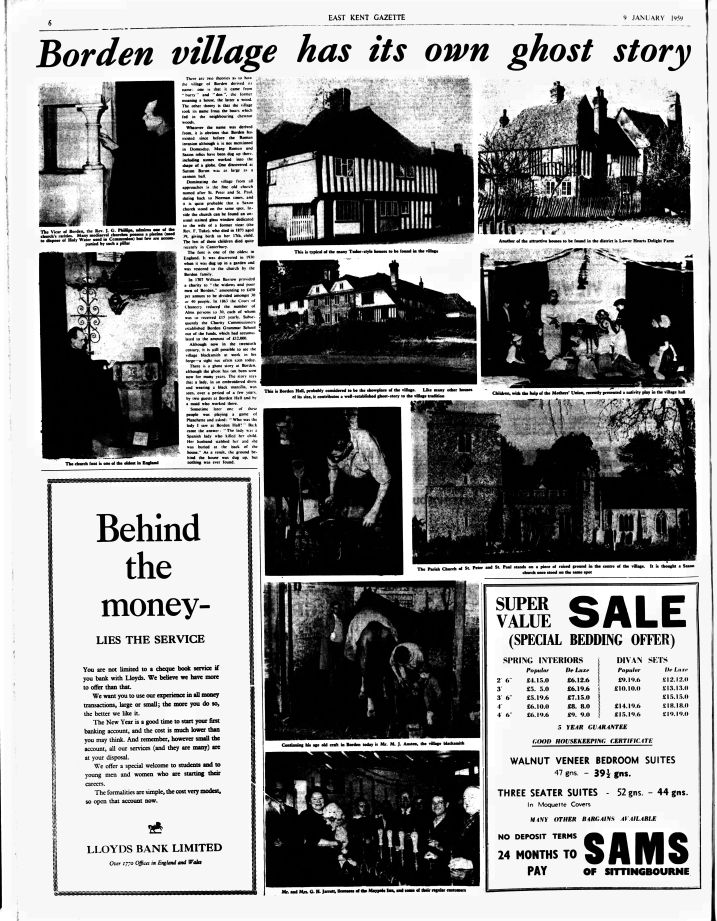
Although now in the twentieth century, it is still possible to see the village blacksmith at work in his forge—a sight not often seen today.
There is a ghost story at Borden, although the ghost has not been seen now for many years. The story says that a lady, in an embroidered dress and wearing a black mantilla, was seen, over a period of a few years, by two guests at Borden Hall and by a maid who worked there.
Sometime later one of these people was playing a game of Planchette and asked: “Who was the lady I saw at Borden Hall?” Back came the answer: “The lady was a Spanish lady who killed her child. Her husband stabbed her and she was buried at the back of the house.” As a result, the ground behind the house was dug up, but nothing was ever found.