Personal Memories Shared (A-M)

Please click on the named titles below to read the personal memories shared with Borden Heritage Group

Some of Marjorie’s memories

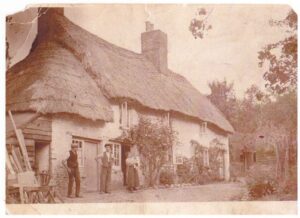
I was born in 1919, we moved from Chestnut Street, photograph shows Mr and Mrs George Sherlock with their daughter Marjorie at Chestnut Street,  into the Forge House in 1922. My Dad (the blacksmith George Sherlock) used to renew the worn tyres on the wagon wheels, in order to do this, he had to remove the big round iron cover which was and still is in front of the Forge, then he had to take off and fix the wheel in the space where the cover was then heat the new tyre on the forge fire. He used to get a bit of help – Uncle Ted Miller, Mr. Payne the shoe mender and anyone in the pub at the time who could stand by with a bucket of water because once the tyre was on it had to be cooled down quickly because the wheel could be set alight by the tyre. My dad made the four arms for the lights in the church when electricity arrived, the old ones had candles which Uncle Ted used to pull up and down on a rope to light, and those same frames are still there.

My Uncle Ted was married to my Dad’s twin sister Aunt Vi, Ted was the odd job man around the village, he helped with anything, he swept chimneys,entertained children, dug graves and every day he climbed the church tower to wind the clock. He was churchwarden and on Sunday mornings he rang the bells for services and played hymns on the bells.

My School days

I started  school at Borden in 1924. There was a spike fence which divided the girl’s playground from the boys all the way round. At one time I used to fill the teachers kettle at the house at playtime, one day I came out and stood up on a form which was against the fence I fell and was left hanging on a spike in my arm. I didn’t feel anything; someone lifted me down and went to fill the kettle. Mrs. Parker’s mother saw blood running down my arm they sent for our neighbour at the Post Office, Ivy Mitchell, and she pushed me home in a pushchair; mum sent for Dr Ind and I had several stitches in the wound. My dad had the job of filing all the spikes down on all the fences. While at the school in later years Mrs. Parker had an order from Borden Grammar School to make some socks for the boys. I used to sit, with another girl, at the back of the class knitting the socks; they were black with white tops.

When I was about 9 or 10 years old I fell in the pond, my friend dared me to walk along the top of the wall, which I did, and fell in on a corner into a pile of stinging nettles where the drains from the houses overflowed into the pond. My dad got a ladder to get me out (the air was blue!)I was stung all over and my Mum put me in a bath of cold water.

When I was still at school we had a club called the ‘Girls Friendly Society’ we used to meet at the Vicarage on Saturday afternoons with Miss Peary she was Mrs. de Spailer’s daughter by her first marriage. We knitted dish cloths, egg coseys and other small items for the church fete; sometimes we played rounders on the Vicarage lawn. The Rev. A. de Spailer was the vicar.

My Life at School House

With my husband and two small children we moved into the School House in 1948. The house was not needed for the new headmaster Mr. Costen as he was living nearby at Key Street. We were on the list for a Council House but because we had two rooms at Forge House with my parents we did not qualify immediately. School House was very dilapidated and damp, with a family of mice living in the walls. There was no gas or electricity, there was an old black coal range, when the wind was the wrong way it blew smoke back in the kitchen. We had a primas stove to boil a kettle and oil lamps and candles for lighting. We made the best of things and tided the place up as comfortable as possible. There was a bathroom and flush toilet but not hot water. It was 1953 when electricity came (bliss) I think the church and the parish partly had to pay for it. Mrs. Godfrey was caretaker and walked from Wises Lane twice a day, we took over when she wasn’t well and took the job when she retired. It was hard work in the school, coal fires to be cleaned out and lit every day and wood floors which had to be scrubbed in the holidays. I was dinner lady for some of the time. We were there for twenty six years when news came that we had been allocated a council house in Newington. We were there for nine years when my son who was living with us decided to buy a property and we moved to back to Borden. I have been in the school recently and did not recognise anywhere, the house has been cut in half and it is now turned into classrooms.

Marjorie Barrett nee Sherlock March 2011

Marjories Playstool memories

The Playstool hasn’t always been the size that it is now, the bottom end was Mr Clinch’s apple orchard, and he lived in a big house since pulled down. After the war the orchard was up for sale and the Council and the villagers raised enough funds to buy it. They held various events and some men coming back from the war gave their gratuities. Six years ago a property developer wanted to buy the apple orchard for house building but it was refused. I for one wrote a letter to the council which I think is now in the archives.

The Maypole dances used to be held on Hinges meadow which is now the Homestead estate then came to the Playstool when it was extended. 

Marjorie Barrett (nee Sherlock) 2012

Borden Heritage Group News
Thursday 14th Dec
Memories of living at Chestnut Wood

We moved here next to Chestnut Wood in October 1959, and my husband and I have never regretted it. With two sons and a dog, and my in‑laws nearby, and my father‑in‑law’s business which is why they lived here, and when our house came vacant we came to live here too. It took all our money and had to get it payed for in eight years. But we done it, no car, had to catch the bus or walk into Sittingbourne. I done it many times.

Can remember going cherry picking for Mrs Triplow who’s ground adjoined Chestnut Wood then. With the money I earned bought some lovely blankets from Hulburds, and had to carry them home all the way. Still have them.

At that time there was only a track and only a few properties. To get up the Lane it was flint stones all the way up. Try pushing a pram over that it wasn’t easy on the legs or arms. When ever he could my husband came to meet me.

Then there was the Lane to think of. A commity was formed it. They concreted two tracks up the lane and left the middle bare. But like all things the milkman came up in a three wheeler and made a track up through the middle so they ended up concreting the whole of the lane.

Chestnut Wood my father‑in‑law bought it when it became vacant and coppiced it to make spiles and chestnut posts, but got (later?) now and again by some who didn’t understand it would all grow again.

The vicar.

One day many years ago we hadn’t been in the house very long. I was all on my own when there came a knock on the front door so I let them knock again and then I got near the front door from inside I called out “Who is it” and a voice came back “It’s the vicar”. (me) “The vicar from way” “The vicar from Borden.” I had a look through a small window and then opened the front door with a big key and had to unlock the door twice. When we met we both said sorry and both laughed. It was the Reverent Phipps.

As I sit writing this at our kitchen table two Cock Pheasants go across the field a few weeks ago we had a fox sitting down and just staring at us as if to say you can watch me, and I can watch you.
 

The ice cream man Mr Winslow mentioned in Marjories story was my Grandfather. I checked with my Aunty today, and she told me that later on he would sell the ice cream from a motorbike and sidecar. The family lived in Gordon Cottages where there were 15 children!

Ann Coker’s memories of Street name choices


All the names were suggested by me.   Andrew Mair and I were the only ones on the Parish Council who really knew anything about Borden history.   As you are probably aware Parish Councils can suggest, there is no guarantee that the Authorities (SBC and Royal Mail) will agree and if they do, they often alter it slightly.


Barn Close was an obvious choice as it was a farmyard at one time.


Homestead View is opposite the house called The Homestead.   We did ask for Homestead Close.


Maylam Gardens.   The land on which it was built was owned by Hinges and Peter Mair’s father, James (Jim), was a Director of the company, his middle name was Maylam.


Greenlees Close.   Alec Greenlees farmed Woodgate Farm at Oad Street and lived at the Farm house on the corner of Woodgate Lane and Oad Street.


Micketts Close.    On the footpath leading to Maylam Gardens from junction of Wises Lane/Cryalls Lane were two cottages called Micketts.


Dental Close.  The land on which this was built was Dental Farm. We did ask for Dental Farm Close.   


Westfield Gardens at Danaway.   On an old map I found that nearby land was Westfield.


Jim Mair and Alec Greenlees did so much for Borden, I felt it only right that they should have some recognition.  


Ann

David - Childhood memories

One of the names read out at our Remembrance Day Service is that of Denis De La Billiere, a Surgeon Commander RN who was presumed drowned when his ship, the cruiser HMS Fiji, was sunk by the Luftwaffe in the battle for Crete in May 1941, after thirteen hours of continuous attack from the air. Of the crew, 520 were saved 244 lost. His captain later wrote that Denis was last seen in the water, and “I don’t doubt that he was always trying in his gentle way to go to the help of some neighbouring swimmer in trouble. I’m sure he was pretty exhausted dealing with the wounded before he even got into the water … He was a wholly reliable and respected doctor, and I dare say his very deliberateness gave the confidence that a hasty man could not command.”

His family, his wife, Kitty and his two sons, Peter and Michael, connection with Borden began in 1937 when Denis was posted to HMS Pembroke (Chatham Dockyard) in1937 and rented The Homestead, described by his son, General Sir Peter De La Billiere in his autobiography, as “a typical, red-brick Kent farmhouse, of medium size, lacking in modern comforts, but with a friendly atmosphere. It belonged to a farmer called Mr Hinge who owned and worked all the land around. He was a kind and tolerant landlord even when Michael and I made ourselves an infernal nuisance to him, and the farm, with its large barns and outbuildings, was an ideal environment for boys who liked being outdoors”.

Sir Peter’s autobiography has some very interesting insights into life in wartime Borden. They lived, he says, in real country, among country people, and their lives were shaped by the rhythm of the seasons. He describes the cherry orchards, but the most exciting time of year was the harvest when primitive binders clattered round the fields of corn causing the rabbits to flee.

All this time the war in the air was raging overhead and he relates how one night a fleeing German pilot unloaded a stick of ten bombs which straddled the village, and that one landed in front of the pub but by a million to one chance plummeted straight down a well outside, containing the explosion. At night when an air raid was expected he and his brother would have to sleep under a steel table in the cellar, but in the morning, they were free to search the fields for pieces of shrapnel, empty cartridge cases and rounds of ammunition which had failed to fire.

In October 1937 he had started at the Frobelian School at 58 Park Road in Sittingbourne. This, incidentally, was a school I myself started at some five or six years later, no doubt on the recommendation of his mother, Kitty, who had become a close friend of my mother.

Sadly, it seems that Peter’s days at Borden did not end entirely happily because, returning home one day, he found a new and by no means welcome element had entered his life. His mother and Major Maurice Bennetts were married at a quiet wedding in Borden Church early in 1943. He, of course, never blamed his mother, who was, he says, still a lively and attractive woman in her mid-thirties, for the new alliance on the rebound from his father’s death, but he and his brother at once took against their step father, and the marriage quickly proved disastrous after the family left Borden and moved to Shropshire.

Robert Hardy

January 2026

Joyce Martin’s (nee Sherlock) Memories

Joyce’s father was the village blacksmith in Borden. His family had lived in the village for several generations. His name was George Cecil Sherlock and having married Minnie May Wittingstall from Faversham, he lived in Forge House from 1922 until his death in 1957, when he was in his early 60s. George had been a farrier looking after army horses during World War 1. He was succeeded as the village blacksmith by Mr Austin.

Joyce’s earliest memories are of Cranbrook Convalescent home, because when she was 5 years old she contracted T.B. and was away from Borden for about one year. Her parents visited her each week travelling from the village by motorbike and sidecar. She returned to Borden village school, but missed a fair amount of schooling through illness. Every Monday she had to attend for a check-up at a clinic at the bottom of Borden Lane. Her doctor was Dr. Robson of Hollybank Hill.

Joyce’s older sister, Marjorie, had been born at a house in Chestnut Wood, while her father was working at the forge in Chestnut Street. Joyce was born in 1923 and her twin brothers, David and George, were born in 1927. As the family grew up they would often visit Leysdown on Sundays and search for cockles. These would be cooked on Mondays, while her mother was busy with the never ending pile of washing, which was washed and boiled in the copper in the scullery.

George the blacksmith was also a wheelwright and so he made many of the wheels for local farm carts. These wheels would be put on the plinth, which can still be seen outside the forge. His wife would be called to help stretch the heated tyre over the frame and if the children were about they would run around with watering cans cooling down the metal. Freddie Payne, a local inhabitant, would often sit on the wall next to Rose Cottage and the forge repairing villagers’ shoes, while watching the comings and goings at the forge.

Joyce’s father was kept busy looking after the horses that worked at Street Farm opposite the church and at Home Farm in The Street. His wages were governed by the farmers and he would get 25 shillings (£1.25) for shoeing each cart horse. The farms were busy places with the horses going about their daily work. There was a regular competition between the farms and the horses would be paraded with their gleaming brasses and braided manes.

Forge House was a large house with three bedrooms and a dressing room that was also used as a bedroom. The meeting room for the Trustees of The Barrow Trust was on the second floor and ran across the two adjoining houses. There being no main drainage at the time there were five cesspools in the garden of Forge House. Friday night was bath night! A zinc bath was filled with water for all the family to use. Rainwater was collected from water butts and boiled-up in the copper before putting it in the bath. Pears soap was used to scrub the children clean. There were no domestic fridges in the 1930s, but the steps to the cellar were used for storing items that needed to be kept cool. During the Second World War, Joyce’s father put matting on the floor of the cellar and white-washed its walls, so that it could be used by the family as an air-raid shelter. When the doodlebugs flew over, the family would spend the night in the relative safety of the cellar and emerge about 6 a.m. The boiler room of The Maypole Pub was hit one night by an incendiary bomb fortunately causing little damage and there was a searchlight battery in School Lane.

A typical weekly menu at Forge House would be: Sunday roast beef, Monday bubble-and-squeak with cold meat, Tuesday liver, Wednesday and Thursday meat pie (that would last for two days)Friday fish, Saturday sausage meat pads

The village post office was in Barrow House, which adjoins Forge House.

The old vicarage was a large imposing building in The Street. The Mothers’ Union met in the vicarage. Joyce remembers the Reverend D’Espelier and his wife being authoritarian. If children misbehaved during church services, Mrs D’Espelier would ‘clump’ them around the head with a hymn book! There was a large tithe barn at the back of the vicarage, where Sunday School parties were held. The children would line-up at these events and be given an orange, an apple and some sweets. Joyce remembers that she once lined-up only to be told that she had not attended Sunday School regularly enough and so would not receive the gifts! The fact that she had been ill was not taken into account. Two kind boys in the line gave her their rewards!

Villagers always attended church dressed in their best clothes. Joyce remembers attending church twice a day – for the main service in the morning and then returning in the afternoon for the Catechism.

Two stained glass windows from the church were removed to Canterbury Cathedral for safe-keeping during The Second World War, but unfortunately it is thought it would be too costly to reinstate them.

A pine tree in the Vicarage garden was reputedly left standing as it was a landmark for wartime aircraft.

BORDEN CHARACTERS

Joyce’s Aunt Vi and Uncle Ted lived at Apple Tree House, which had been the village workhouse in earlier times. Their son, Cecil, would often remind them of the origins of their home, much to their annoyance! Vi was responsible for cleaning the church for many years.

Miss Goodger worked at Sutton Baron House. She walked along the footpath beside Miss Greensted’s shop and carried a hatpin with her as protection on the lonely paths.

Miss Greensted (Caroline?) and her mother owned the village shop (where the bridleway to Bredgar leaves Borden opposite the church). The shop was loved by village children for the range of sweets it sold. Cheese and butter were stored in the cellar and brooms and brushes could also be bought at the shop.

Miss Perkins lived in St. Martin’s Cottage. She grew artichokes in the garden and she would get water from a well hidden under flagstones in her kitchen.

P.C. Pike and P.C. Wignall were two local policeman, who patrolled the village and knew the inhabitants well in the 1950s and 60s.

Joyce remembers the village shop being decorated at Christmas and brimming with exciting goodies. The owners at one time were Mr and Mrs Downs. They had an old oak clock which stood on a sideboard near to the stairs to the cellar. Biscuits at the time were sold separately and you could choose the individual types you wanted. Butter was patted up to the amount you wanted. There was a door from the shop to Mr Giles the butcher. Mr Wood would pluck turkeys.

In far more recent times in the 1990s, Rodney Kimber in the village shop is remembered for having a newspaper and a cup of coffee, while he waited for customers in the mornings and changing to a book and a coffee in the afternoons. In the latter days of the village shop, he took an interest in dolls houses and would build them and sell items to go in them.

Long before the Kimbers had the village shop, a Mr Gage would deliver fresh fish in a small white van once a week and there was another man who bought fish and chips to the village in a mobile van.

Mr Hemsley delivered milk by pony and cart. Mr Whitehead from Munsgore dairy also bought milk to the village.

The nearest bread shop was in Neal’s Bakery on the main road (A2) near where The Pines Nursing Home (The Firs) is situated.

Mr Friday was the road sweeper. Each day he would walk from his home in Berry Street in Sittingbourne to Borden. He would then eat bread and cheese for his breakfast and then he would collect his cart for his daily work. He would sweep from the church to Harman’s Corner and he was also responsible for keeping gullies and drains clear and making sure that hedges were kept tidy and in order. Every Saturday he would clean his tools and arrange them neatly in their place of storage, so that they were ready when he resumed work the following Monday.

Joyce’s father, the blacksmith, would also spend Saturdays cleaning his benches and windows and sharpening and cleaning his tools, so that the forge was clean and tidy for work at the beginning of the new week.

Old Sedgey, who lived in a large house situated on the corner of Bannister Hill and The Street, would sell pigeons in the morning at various places away from the village, but being trained as homing birds, they would quickly return to him! He had a son Georgie, who is remembered for often hanging over his fence with a bag over his head!

At Bannister Hill there were four wooden cottages, each having just two rooms and a kitchen. One was lived in by a family of six and in another lived Alfie Hills and his mum. He is remembered for his enjoyment at village fetes of frequently sitting in a wheelbarrow while water was poured over him.

Two ghostly appearances in Borden are of a Spanish lady with connections to Borden hall who is thought to haunt its interior. She is believed to have buried a baby under the yew tree that used to exist close to the west door of the church. Close to Posiers, a lady in a crinoline dress was once seen to float across the road.

SCHOOL DAYS

The village school pupils were involved with the May Day celebrations. A large maypole was erected in the lower field at The Playstool. The boys would wear biscuit coloured smocks and the girls wore white smocks as they danced around it.

In the 1930s Mr Taylor and Mr McCulloch were the headteachers. The cane was used as a punishment in the school. The toilets were away from the main building and would freeze up during the cold winters. The two Miss Edwards wore their hair up and tied in a bun. They wore the same colour dresses – maroon one week and blue the following week. The pupils would queue for Mrs Parker to give them their daily free one-third of a pint of milk with a Horlicks tablet. They were also given regular doses of cod liver oil to keep colds away. Miss Howes rode a motorbike called ‘James’. She had a big weaving loom in her classroom, which the children used to make mats. Mrs Barrett (Joyce’s sister, Marjorie) was the caretaker for twenty-five years and lived in the schoolhouse.

The pupils would play hop-scotch. They used spinning-tops, which they would whip from the church gate to the shop and they would play with iron hoops.

Joyce particularly enjoyed collecting wild flowers from the hedgerows, which were put in 2lbs. jam jars and displayed at school. White mice were kept at school and during the holidays, Joyce volunteered to look after them at home.

Joyce and her friend, Joan Young, would often take a bottle of water and a couple of biscuits and wander in the local farmland, particularly going down the Half-Mile Path to Oad Street, where they would search for newts.

Joyce belonged to the Girl Guides. About a dozen girls used to meet in a house in Borden Lane. They would go camping at Syndale Bottom near Newnham, where she remembers hearing the gypsies singing as they went about their hop picking. The girls also enjoyed charabanc outings to Joss Bay.

During wartime a 6d (penny) Hop was held regularly in the Parish Hall. The hall had previously been an army hut in Sheerness and it was transferred to the village in 1921. Whist drives, dances and amateur dramatics often took place there.

Joyce has fond memories of hop and cherry picking in the local area. She would take bread and cheese and a flask of tea and spend many happy hours picking hops in Cryalls Lane.

She left the village school when she was 14 years old and went to help look after a blind daughter of staff at The Kent Farm institute in Riddles Road. She then went to work for Gobbles shop in the High Street, where Central Avenue is now. They were renowned for hams, but her new employer was a real taskmaster.

PS James was a haberdashery shop near to where The Forum is now. Flannelette for winter shirts would be bought there and the money would be taken in small screwed containers on tracks hanging from the ceiling to a central cashiers’ office.

Close to the Abbey Bank is in Sittingbourne High Street there was a grocery shop called Maypoles. Around the shop were ceramic tiles of rural scenes of cattle in fields. These tiles have recently been rediscovered on the walls in what is now a cafe and so Joyce has been able to admire them again.

A bus to Doddington would pick up passengers from near the forge and take them to Sittingbourne.

Joyce has memories of Borden over a very long time, but she really misses the village shop, which was a meeting place for the local community.

The Forge

I was born in 1919, we moved from Chestnut Street into the Forge House in 1922. My Dad (the blacksmith George Sherlock) used to renew the worn tyres on the wagon wheels, in order to do this he had to remove the big round iron cover which was and still is in front of the Forge, then he had to take off and fix the wheel in the space where the cover was then heat the new tyre on the forge fire. He used to get a bit of help – Uncle Ted Miller, Mr. Payne the shoe mender and anyone in the pub at the time who could stand by with a bucket of water because once the tyre was on it had to be cooled down quickly because the wheel could be set alight by the tyre. My dad made the four arms for the lights in the church when electricity arrived, the old ones had candles which Uncle Ted used to pull up and down on a rope to light, and those same frames are still there.

Recorded by Frances Platten for BHG 2011

Roger’s Memories

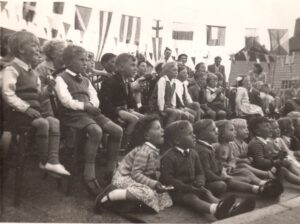
I had a question posed to me from a friend that I grew up with on the old Mount View Estate, that you may be able to answer for me, the photo that I have provided was taken of No 25 and No 27 Mount View Borden at the celebration of the coronation of Queen Elizabeth the 2nd . I lived at No 25 (on the right) and the Parkhouse family lived at No 27, my question is – in the middle of the green there was a large Weeping Willow Tree, when was it planted and was it planted for a special occasion? As can be seen there is not a tree on the green and if it was planted for a special occasion then what was the occasion? The only one I can think of is the Coronation of the Queen, but I may well be wrong.

If per chance you find the answer can you, please put it on the BHG page as there are a few from the Estate that I’m sure would be interested in the answer.

Incidentally the clown is performing at the same occasion the street party for the coronation of the Queen and I do believe it was Mr Fielder who lived on the Estate that played the part of the clown

More Memories

I was born and raised in Borden until I got married at the age of 22. My mother and her family all grew up in Borden. My grandfather was the local blacksmith, and I remember very well watching him shoe the big Shire horses and helping him by operating the bellows on the forge to get the coals hot and then watching him shape and fit the shoe to the horse, and then that wondrous smell of the horse’s hoof burning so that the shoe would fit neatly to the hoof. Granddad had the forge until his death, Nan then moved to Banister Hill in one of the small cottages on the left-hand side.
The old vicarage was pulled down to make way for four new bungalows between the farm and St Martins cottages. There was also a very large house that stood were Coppins Lane (New Private Estate) now stands . Coppins lane was built on the ground that was old man Sedges place, he and his son George lived in there. It was once called Coppins Farm hence the name of the new estate, Old man Sedge had a big grey beard and to me as a small boy looked very frightening his house was surrounded by a flint wall about six foot high  with broken glass cemented on the top to stop people climbing over the top. Old man Sedge or his son sold homing pigeons, the problem was when he sold them to a customer they would come home to George and not the new owner.
      I personally lived on the old section of the Mount View Estate down by the roundabout with the willow tree in the middle.
We would go to the local village shop owned by Mr. Woods and in the old butcher’s section he would put on a toy display at Christmas and we would look at all the toys in the window and secretly yearn for them. We would walk to school, up through the village and through the churchyard and on down into School Lane, finally reaching Borden Chalk hole College, as it was commonly called. My aunt and uncle were the caretakers of the school and also lived there on a permanent basis (the Barrett’s). The headmaster was Mr. Costin, a bald-headed ogre of a man who would frighten the very life out of us with his booming voice, and it was nothing to get your ears boxed for a little mishap or giving the wrong answer to a question. His wife took us for music, Mr. Jenkins was another teacher, and for kindergarten there were the two Miss Edwards, sisters I believe – when they retired their place was taken by Miss Delaine.
When Borden held its fete at the Playstool the local school would show its skill in Maypole dancing. There would be all the fun of the fair, like the coconut shy, wobbly bikes and the local farmers’ stalls, and of course there would be all sorts of races for us kids, like the egg and spoon race and the sack race, and there would be marching bands to watch and also farm skills and machinery.
Both my brothers and I were in the local church choir and at one time we had three sets of twins in the choir. My brother and I are identical twins, as were the Brett twins (girls) but the Fitz-Williams twins were not identical. The local paper came up and took our photo and put it in the paper as it was a bit of an achievement for three sets of twins, in fact there was another set of twins that went to the same school and they lived at Chestnut Street, they were the Ruck twins (girls).
After school and on the weekends we were never home, we were always out playing either on the Playstool or down the chalk hole just off Cryalls Lane or in the Pug Hole that was between the Playstool and the chalk hole. I still have a scar on my right hand from playing in the chalk hole and cutting it open on a flint that was stuck in the chalk.
Our estate was surrounded by cherry orchards and hop fields, and also fields with other crops that were in season at the time. The local dairyman was George Waters, and us kids would sit on the gate in the dairy and watch George milk the cows and he would aim the teat at all of us (about 6 kids) and get all of us in the face with warm milk straight from the udder and we would end up with milk all over us, then we would help with moving the cows to a different pasture.  My brother and I would cycle up and around the Square to Oad Street and meet up with our friends and get up to all sorts of mischief, but nothing that would cause damage to property (well maybe once) or hurt anybody, just good fun.
Mum still lives in Borden, as do a lot of the people that I knew as a child, but the house that I grew up in has been pulled down and the estate has now got twice as many people living in the same amount of land. We had a huge garden as a child and Dad grew all the family veggies in the garden, ranging from basic veggies to apples and gooseberries, redcurrants and blackcurrants.
I went back to Borden in 1995 and there has not been a lot of change, and that pleases me, as it’s nice to see the old cottages at Harman’s Corner still there and the thatched cottages down Wises Lane, but the allotments have now gone as has the shop in the village. Mum said that things have changed for the worst and I think she could be right. I miss the clip clop of the horses in the village and she hankers for the days as they used to be, but you cannot turn back time.
I hope that I have brought back a few memories of Borden even if it is for one person and that I have put a smile on people’s faces. I now live in Australia and hope to go back to Borden in sometime soon – if anybody remembers me then I hope to see you then.
Regards,
Roger Martin

Margaret shared these memories with me on 25th October 2016. Margaret’s early life was spent in in Yorkshire, she moved to Africa as a young woman before moving again to Kent. In 1970 Margaret moved to Borden, from Rainham, with her family and started Fundraising for Ss Peter and Paul Church after being introduced to Mrs Mary Giddy who told her funds were required the fundraising then progressed with the need for a new Parish hall and the Nature reserve. 

The Thrift and craft days were held monthly in old hall (Margaret had, very successfully, held similar events in Rainham for the local Seas Scouts) The event was moved to the vicarage, when the old hall became unusable, the Rev Davis was persuaded that no damage would be done to his home and Margaret Bryant supplied a large roll of plastic to protect the vicarage carpet. Local residents sold their own goods (cake icing tools, jewellery etc.) and produce (fruit, vegetables, cakes etc.) the stall holder could make money for themselves and at least 10% was donated for funds. Margaret’s mother used to cut buttons from unsold jumble and sew them on to cards for sale. A potter from Benchley house AEC sold pots. Margaret ran a monthly meat raffle. Drinks Parties and Garden parties were other fundraisers 

Musical evenings at St Martin’s were hosted by Margaret and her family, Margaret played the Clarinet, her husband Albert played the piano and they were joined by the singer Judith Lowe. 

Margaret organised ‘Dress days’ that raised in excess of £5000. Margaret was raising funds for toilets in the church, hymn books and choir robes. A friend of Margaret’s supplied new clothes for sale; guests could try on clothes without the need to purchase and browse the bargain rail. Coffee and lunch were provided by Pauline Cole and Carol Gabriel and friends, publicity leaflets were circulated together with numbered envelopes holding strips of raffle tickets that were presold. 

Borden Fete included ‘Hook the silver fish’ and a ‘Gerbil race’ run by Margaret’s son Peter. 

Fundraiser committee meetings were held at her home, and included Win.Wilson, Pat Barnett, Rose Faulkner, Margaret Bryant (treasurer) and a lady who lived in the house that Dr Cockrill moved into. Meeting had to finish by 8.55pm because Margaret Bryant left at 9pm to retire for the evening. 

·The Nature Reserve committee, was Margaret’s idea, the land was formerly a chalk pit and used as a Borough Council refuse tip. 

A friend of Margaret commented that she is a great innovator and suggested that Innovators seldom wear the Crown; Margaret says her reward is seeing money raised. 

Margaret was an enthusiastic motivator, caring for others and sharing her life within the community. Margaret’s life time of service to others was recognised by Borden Parish Council in July 2019 when she was made a Freewoman of Borden 

Eileen Harrison 

Joyce Pollington remembers Borden

During World War Two we – my Mum and older brother, Tom, and sister, Pam – lived at number 8 Duvard’s Place in Borden. We were there from when I was just 5 (1940) and left one month before my 12th birthday. We struggled along
manfully during the war, as did so many others. One day on the way to school we saw that one house had been hit and the front of the house wasn’t there. But the cupboard on the landing had a Union Jack in and the flag had unrolled as it fell out and fluttered there.

My Uncle was in the fire service in London and when he managed to get down to visit he brought boxes of sweets with him. Gran (Mrs. Lilian Pollington) used to put a table outside the front door and sell them. At other times my Aunt Mary (only in her early teens then) used to go round the villages selling the sweets from a tray around her neck. The bus only came up to the Maypole and when Mary went round with the sweets at the weekend she had to go all the way up to Oad St. That was quite a walk along the road directly opposite Gran’s cottage.

There was a pub up there – and still is, I believe.

When Mary was working age (14 probably) she went to work in the hospital at Keycol Hill. I think she had to scrub (on her hands and knees) a long corridor, clean the nurses’ home and Matron’s sitting room.

I don’t remember much about my Grandad (Edward Pollington) and he died in December 1940 at 1 North Street, Milton (not sure what the address was but maybe a nursing home or hospital) and was buried in the churchyard. When Gran died in 1966 a small number of the family took her ashes to the churchyard and scattered them on Grandad’s grave although he didn’t have a headstone – Gran couldn’t afford one.

Gran and Grandad and my Aunt Mary lived at number 2 Wents Cottages which was the middle one of three. Entering the cottage by the front door there were stairs to the left. On the right was a sitting room which was used, at some time, as a bedroom for an old lady who was probably Gran’s mother. Directly opposite the front door was a door to the living room and facing that door was Grandad’s armchair – wooden, like a farmhouse carver chair. The chair had a wooden railed back which was his ‘itching post’ and he would twist his back to itch his back – or maybe relieve pain. There was a large table to the left which seemed to take up most of the room and there may have been a form-type bench at the back. Facing into the room from the hall the kitchen or scullery was on the right, the door being next to Grandad’s chair. I don’t know how many bedrooms there were but probably only one for Gran and Grandad and another
for Mary.

When the war finished, in 1945, Gran must have gone back to London, leaving us to await Dad’s discharge from the Army. We left Borden because my brother, Tom, was coming up to school leaving age and it was decided that we needed to return to London as a family to give us all a better chance of finding work. So, in March 1948 we went back to London.

I think Duvard’s Place was probably a farm worker’s cottage and we had two wells: one for drinking and one for washing and we had a rain butt. The mangle was outside the kitchen window. The row of cottages was ‘tunnel back’ and we lived at the end cottages. The people next door were called Tilbey. The front room was the best room and only used for special events. The war was in full swing when we moved to Borden and so we were the proud owners of a table shelter. This was a large steel table with mesh wire sides to keep out the flack when bombs fell. We all slept under that table until the war ended.

One day we three children were in the garden and an enemy plane came over very low; we could see all the markings on the plane. I do recall that a plane came down near us and the pilot was buried in the churchyard. If you were in the village it was a must to go round the back of the church to look at the grave.

While we were at Borden we seem to have fared very well. Of course, we had fruit and Mum made jam. We also had an allotment and grew vegetables. Our cottage was about a mile outside the village and although there was a bus to the village we had to walk the mile to catch it. The school was another mile on from there. My best memories of school are that we had cold toast for our lunch wrapped in newspaper and we took an Oxo cube for a hot drink to go with the
cold toast. One teacher was called Begby, known to us as ‘Buggerbee’.

Sometimes, we had ice cream and we had little round circles of ice cream two inches across and one inch deep.
There was a time when Mum, along with other Mums, kept us off school in protest that there was no provision for us at lunchtime. I expect that was when the Oxo drink was provided.

In the village, Barrow House was the one next to the forge and sometimes used as a library. Looking from the village to the church the Post Office was on the left before the forge and it was also a small general store. On the right before the pub was the ‘rec’ and each year we had a fete and fancy dress parade. To get to school we had to walk the mile to the church turn left just before the church and walk another three quarters of a mile to the school. The school was built of flint and had four classrooms. At Christmas a local farmer sent nuts and fruit to the school for the children. I remember the boys having stained hands from peeling the nuts so perhaps they were walnuts.

The Vicarage is now next to the Church but it used to be down the main street towards Harman’s Corner and I think the Vicar’s name was Brown. Sometimes a dance was organised in the Village Hall opposite the Church.
There used to be a man who did hedging and ditches on the roads around the village and we knew him as ‘Man Friday’.

(Thomas, Pamela and Joyce Pollington appear in the school register for 1941 with their address as Duvard’s Place and Tom and Pam appear in a school photo on the website.) 

Scroll to Top